Venus: The Hellish World Behind the Veil
Venus is often called Earth's twin due to its similar size and mass, but the two planets could not be more different. While Earth is a haven for life, Venus is a hellish world with surface temperatures hot enough to melt lead (465°C/870°F), crushing atmospheric pressure 92 times that of Earth, and clouds of sulfuric acid. This extreme environment is the result of a runaway greenhouse effect that transformed Venus from a potentially habitable world into the hottest planet in the solar system. Despite being closer to Earth than Mars, Venus has been far less explored due to the challenges of surviving its harsh conditions. Recent missions and proposed future missions are revealing that Venus may have been habitable in the past and could even harbor life in its upper atmosphere today. This article explores Venus's extreme environment, its geological history, the mystery of its retrograde rotation, and the ongoing efforts to understand this enigmatic world.
In Simple Terms
Imagine a planet that's like Earth's evil twin—same size, but completely different! Venus looks beautiful from far away (it's the brightest thing in the night sky after the Moon), but up close it's like a nightmare. The surface is so hot it could melt lead, the air pressure would crush you like you were deep underwater, and it rains sulfuric acid (the same stuff in car batteries). Venus is actually hotter than Mercury, even though Mercury is closer to the Sun, because Venus has a super thick atmosphere that traps heat like a giant blanket—this is called a runaway greenhouse effect. What's really weird is that Venus spins backward compared to most planets, and it spins so slowly that a day on Venus is longer than its year! Scientists think Venus might have been more like Earth billions of years ago, with oceans and maybe even life, but something went wrong and it turned into this hellish world. There's even a possibility that tiny life forms could be floating in the clouds high above the surface, where it's cooler and the pressure is more like Earth's. Venus is like a warning sign for what could happen to a planet if the greenhouse effect gets out of control.
Abstract
Venus is the second planet from the Sun, orbiting at an average distance of 108.2 million kilometers (0.72 AU). With a radius of 6,052 km and a mass of 4.87 × 10²⁴ kg, Venus is nearly identical in size to Earth but has evolved along a completely different path. The planet's thick atmosphere, composed of 96.5% carbon dioxide with clouds of sulfuric acid, creates a runaway greenhouse effect that maintains surface temperatures of 465°C—hotter than Mercury despite being farther from the Sun. The atmospheric pressure at the surface is 92 bar, equivalent to being 900 meters underwater on Earth. Venus rotates retrograde (backward) and extremely slowly, with a day (243 Earth days) longer than its year (225 Earth days). The planet's surface is geologically young, with most features less than 500 million years old, suggesting recent global resurfacing events. Radar mapping by the Magellan mission revealed a world dominated by volcanic features: vast lava plains, shield volcanoes, and pancake domes. Despite the harsh surface conditions, the upper atmosphere (50-60 km altitude) has Earth-like temperatures and pressures, leading to speculation about the possibility of microbial life in the clouds. Recent discoveries of phosphine gas in Venus's atmosphere have sparked renewed interest, though the detection remains controversial. This article reviews Venus's extreme environment, geological history, atmospheric dynamics, and the prospects for future exploration.
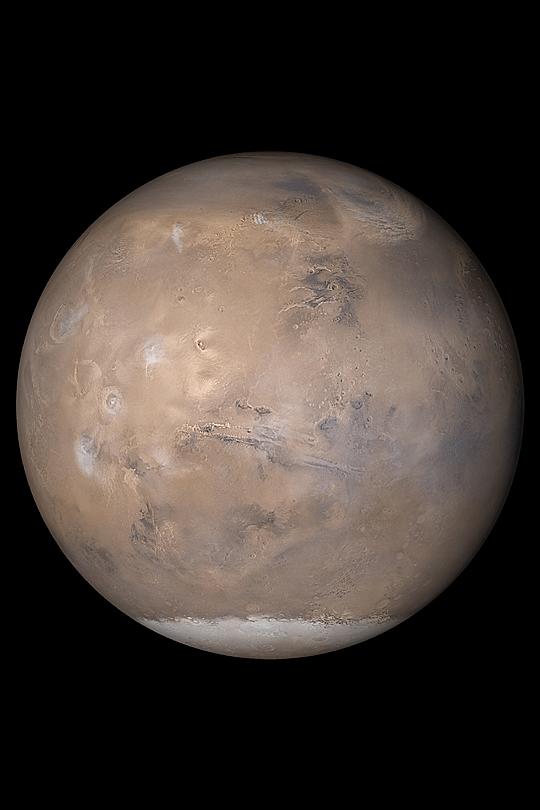
 Venus as seen by the Magellan spacecraft using radar imaging, revealing its volcanic surface beneath the thick clouds. Credit: NASA/JPL (Public Domain)
Introduction
Venus has fascinated and frustrated astronomers for centuries. As the brightest object in the night sky after the Moon, Venus has been observed since ancient times, but its surface remained completely hidden until the advent of radar imaging. Early observations revealed only a featureless, brilliant cloud cover, leading to speculation that Venus might be a tropical paradise or a global ocean. The reality, discovered by space missions in the 1960s and 1970s, was far more extreme: a hellish world where lead would melt, where the pressure would crush a submarine, and where sulfuric acid rains from the sky.
The Soviet Venera missions of the 1970s and 1980s provided the first—and so far only—direct images from Venus's surface, showing a rocky, desolate landscape under an orange sky. These missions, which lasted only minutes before being destroyed by the extreme conditions, revealed a world that had taken a dramatically different evolutionary path than Earth.
Today, Venus is experiencing a renaissance in exploration. NASA's Magellan mission (1990-1994) mapped 98% of the surface with radar, revealing a geologically active world. Recent missions like ESA's Venus Express (2005-2014) and JAXA's Akatsuki (2015-present) have studied the atmosphere in detail. Proposed missions, including NASA's DAVINCI+ and VERITAS, and ESA's EnVision, promise to revolutionize our understanding of Venus in the coming decade.
Physical Characteristics
Basic Properties
Venus is nearly Earth's twin in size and mass:
- Radius: 6,052 km (0.95 Earth radii)
- Mass: 4.87 × 10²⁴ kg (0.815 Earth masses)
- Density: 5.24 g/cm³ (slightly less dense than Earth)
- Surface gravity: 8.87 m/s² (0.91 times Earth's gravity)
- Escape velocity: 10.36 km/s
Despite these similarities, Venus has no magnetic field and no moon, and rotates in the opposite direction to most planets.
Orbit and Rotation
Venus has the most circular orbit of any planet:
- Semi-major axis: 108.2 million km (0.72 AU)
- Orbital period: 225 Earth days
- Eccentricity: 0.007 (nearly circular)
- Rotation period: 243 Earth days (retrograde)
- Solar day: 117 Earth days (sunrise to sunrise)
Venus rotates retrograde—backward compared to most planets. A day on Venus (one rotation) is longer than its year (one orbit), and because of the retrograde rotation, the Sun rises in the west and sets in the east. The cause of this retrograde rotation is unknown but may be related to a massive impact early in Venus's history or tidal interactions with the Sun.
The Runaway Greenhouse Effect
Extreme Surface Conditions
Venus's surface is the hottest in the solar system:
- Surface temperature: 465°C (870°F) - constant day and night, pole to pole
- Atmospheric pressure: 92 bar (92 times Earth's sea-level pressure)
- Atmosphere composition: 96.5% CO₂, 3.5% N₂, trace gases
These conditions result from a runaway greenhouse effect. Here's how it works:
-
Initial heating: Early in Venus's history, the Sun was cooler, but Venus received more solar radiation than Earth due to its proximity.
-
Water vapor feedback: Any water on the surface would have evaporated, and water vapor is a powerful greenhouse gas, trapping more heat.
-
Runaway: As temperatures rose, more water evaporated, creating more greenhouse effect, raising temperatures further in a positive feedback loop.
-
Water loss: Eventually, temperatures became so high that water molecules in the upper atmosphere were broken apart by solar ultraviolet radiation, and the hydrogen escaped to space. Venus lost its water forever.
-
Current state: Today, the thick CO₂ atmosphere traps infrared radiation so effectively that the surface temperature is maintained at 465°C regardless of location or time of day.
Comparison to Earth
Earth has a moderate greenhouse effect that keeps the planet habitable. If Earth had no atmosphere, the average temperature would be -18°C. The greenhouse effect raises it to +15°C—a difference of 33°C. On Venus, the greenhouse effect raises the temperature by approximately 500°C above what it would be without an atmosphere.
Atmospheric Structure and Dynamics
Cloud Layers
Venus's atmosphere extends to approximately 250 km altitude and is divided into several layers:
Lower atmosphere (0-50 km):
- Dense, clear of clouds
- Temperature and pressure decrease with altitude
- Contains most of the atmosphere's mass
Middle cloud layer (50-70 km):
- Main cloud deck composed of sulfuric acid droplets
- Temperature: 0-50°C (relatively Earth-like)
- Pressure: 0.5-2 bar
- This is where potential life might exist
Upper atmosphere (70-250 km):
- Thin, wispy clouds
- Temperature increases with altitude in the thermosphere
- Fast-moving winds (super-rotation)
Super-Rotation
One of Venus's most mysterious features is super-rotation—the atmosphere rotates much faster than the planet itself:
- Surface rotation: 243 Earth days (retrograde)
- Cloud-top rotation: 4 Earth days (prograde)
- Wind speeds: Up to 100 m/s (360 km/h) at cloud tops
The cause of super-rotation is not fully understood but likely involves:
- Solar heating creating thermal tides
- Momentum transfer from the surface
- Wave interactions in the atmosphere
Weather and Climate
Despite the extreme conditions, Venus has weather:
- Sulfuric acid rain: Forms in the clouds but evaporates before reaching the surface
- Lightning: Detected by multiple missions, though less frequent than on Earth
- Atmospheric waves: Various wave patterns observed in cloud structure
- Polar vortices: Complex, double-vortex structures at both poles
The weather patterns are driven by the planet's slow rotation and the intense solar heating, creating a unique atmospheric circulation system.
Surface Geology
Global Resurfacing
Venus's surface is remarkably young and uniform in age:
- Average surface age: 300-500 million years
- Few impact craters: Only ~1,000 identified (compared to hundreds of thousands on the Moon)
- Uniform distribution: Craters are randomly distributed, suggesting the entire surface was resurfaced at roughly the same time
This suggests that Venus experienced one or more catastrophic global resurfacing events, possibly caused by:
- Massive volcanic eruptions
- Complete crustal overturn
- A transition in interior heat transport
Volcanic Features
Magellan's radar mapping revealed that volcanism dominates Venus's surface:
Lava plains: Cover ~80% of the surface
- Smooth, radar-dark regions
- Formed by extensive flood volcanism
- Similar to lunar maria but much more extensive
Shield volcanoes: Over 1,600 identified
- Largest: Maat Mons (8 km high, 400 km across)
- Similar in form to Hawaiian volcanoes
- Many appear to be geologically recent
Pancake domes: Unique to Venus
- Flat-topped, steep-sided volcanic features
- Formed by highly viscous lava (likely rhyolite or dacite)
- Indicates diverse volcanic compositions
Coronae: Circular features with concentric rings
- Formed by upwelling mantle plumes
- May be related to hot spots
- Unique to Venus
Tectonic Features
While Venus lacks Earth-style plate tectonics, it shows evidence of tectonic activity:
Tessera terrain: Highly deformed regions
- Complex, intersecting ridges and valleys
- May be remnants of ancient crust
- Covers ~8% of the surface
Rift valleys: Linear depressions
- Similar to Earth's rift valleys
- Indicate crustal extension
- Some are hundreds of kilometers long
Ridge belts: Linear mountain ranges
- Formed by compression
- Indicate crustal shortening
- May be related to mantle convection
Impact Craters
Venus has far fewer impact craters than expected:
- Total identified: ~1,000
- Size range: 3-280 km in diameter
- Distribution: Random, indicating uniform surface age
- Preservation: Many craters show evidence of volcanic flooding or tectonic modification
The paucity of craters, combined with their random distribution, strongly supports the global resurfacing hypothesis.
The Mystery of Life in the Clouds
Habitable Zone in the Atmosphere
While Venus's surface is completely inhospitable, the upper atmosphere presents a different picture:
- Altitude: 50-60 km
- Temperature: 0-50°C (Earth-like)
- Pressure: 0.5-2 bar (similar to Earth's surface)
- Protection: Clouds block most harmful UV radiation
These conditions have led to speculation that microbial life could exist in Venus's clouds, similar to extremophiles in Earth's atmosphere.
Phosphine Detection
In 2020, researchers reported detecting phosphine gas (PH₃) in Venus's atmosphere:
- Concentration: ~20 parts per billion
- Altitude: 50-60 km
- Significance: On Earth, phosphine is primarily produced by biological processes
The detection sparked intense debate:
- Skeptics: Argue the signal could be explained by sulfur dioxide or measurement errors
- Proponents: Note that known abiotic processes cannot easily explain the observed levels
- Status: The detection remains controversial and unconfirmed
Future missions, particularly DAVINCI+, will search for phosphine and other potential biosignatures.
Exploration History
Early Missions
Mariner 2 (1962): First successful Venus flyby
- Confirmed extreme surface temperatures
- Detected no magnetic field
- Measured atmospheric composition
Venera missions (1961-1984): Soviet exploration program
- Venera 7 (1970): First successful landing, transmitted for 23 minutes
- Venera 9-14: Returned first images from the surface
- Venera 15-16: Radar mapping of the northern hemisphere
Pioneer Venus (1978-1992): NASA orbiter and probes
- Mapped atmosphere structure
- Studied cloud composition
- Measured surface properties
Magellan (1990-1994)
NASA's Magellan mission revolutionized our understanding of Venus:
- Radar mapping: 98% of surface mapped at 100-200 m resolution
- Discoveries: Young surface, extensive volcanism, no plate tectonics
- Legacy: Data still being analyzed today
Recent and Current Missions
Venus Express (ESA, 2005-2014):
- Studied atmosphere dynamics
- Detected possible recent volcanism
- Mapped surface temperature variations
Akatsuki (JAXA, 2015-present):
- Studying atmospheric dynamics
- Monitoring weather patterns
- Searching for lightning and volcanic activity
Future Missions
DAVINCI+ (NASA, planned 2029):
- Descent probe to study atmosphere composition
- Will search for phosphine and other biosignatures
- High-resolution imaging during descent
VERITAS (NASA, planned 2031):
- Radar mapping at higher resolution than Magellan
- Studies surface composition and geology
- Investigates recent volcanism
EnVision (ESA, planned 2030s):
- Comprehensive study of Venus's surface and atmosphere
- Radar, spectroscopy, and radio science
- International collaboration
Open Questions
Many fundamental questions about Venus remain unanswered:
- Why the runaway greenhouse? What triggered it, and could it happen to Earth?
- Recent volcanism? Is Venus still volcanically active today?
- Life in the clouds? Could extremophiles exist in the upper atmosphere?
- Retrograde rotation: What caused Venus to rotate backward?
- Interior structure: What is the composition and state of Venus's core and mantle?
- Water history: How much water did Venus have, and when did it lose it?
Future missions will address these questions, revealing whether Venus was once Earth-like and whether it could harbor life today.
Conclusion
Venus stands as a stark warning and a fascinating mystery. It shows how a planet similar to Earth can evolve into an uninhabitable hellscape through a runaway greenhouse effect—a process that has implications for understanding climate change on Earth. Yet Venus also holds secrets about planetary evolution, the potential for life in extreme environments, and the diversity of worlds in our solar system. As new missions prepare to explore Venus in the coming decade, we stand on the verge of revolutionary discoveries about this enigmatic world and what it can teach us about our own planet's past, present, and future.
For related topics:
- Earth - Venus's twin planet and our home
- Mars - The other inner planet
- Mercury - The innermost planet
- Moon - Earth's natural satellite
- Planetary Science & Space - Overview of planetary science topics
^[NASA Solar System Exploration - Venus] NASA. (2024). Venus: In Depth. NASA Solar System Exploration. https://solarsystem.nasa.gov/planets/venus/in-depth/
^[Magellan Mission] NASA. (2024). Magellan Mission to Venus. NASA Jet Propulsion Laboratory. https://www2.jpl.nasa.gov/magellan/
^[Venus Express] ESA. (2024). Venus Express. European Space Agency. https://www.esa.int/Science_Exploration/Space_Science/Venus_Express
^[Akatsuki Mission] JAXA. (2024). Akatsuki (PLANET-C). Japan Aerospace Exploration Agency. https://www.isas.jaxa.jp/en/missions/spacecraft/current/akatsuki.html
^[Phosphine on Venus] Greaves, J. S., et al. (2021). Phosphine gas in the cloud decks of Venus. Nature Astronomy, 5, 655-664.
^[Venus Global Resurfacing] Strom, R. G., et al. (1994). The global resurfacing of Venus. Journal of Geophysical Research, 99(E5), 10899-10926.
^[Venus Atmosphere] Limaye, S. S., et al. (2018). Venus' spectral signatures and the potential for life in the clouds. Astrobiology, 18(9), 1181-1198.
^[DAVINCI+ Mission] NASA. (2024). DAVINCI+. NASA Goddard Space Flight Center. https://www.nasa.gov/goddard/feature/da-vinci
^[VERITAS Mission] NASA. (2024). VERITAS. NASA Jet Propulsion Laboratory. https://www.jpl.nasa.gov/missions/veritas
Recommended Reading
Non-Fiction
For readers interested in learning more about Venus, the following highly-rated books provide excellent coverage:
-
Sheehan, W., & Limaye, S. S. (2022). Venus (Kosmos). Reaktion Books. ISBN: 978-1789145854 - Comprehensive modern overview of Venus, covering its history, exploration, and current scientific understanding. Highly rated at 4.7 stars.
-
Grinspoon, D. H. (1998). Venus Revealed: A New Look Below The Clouds Of Our Mysterious Twin Planet. Basic Books. ISBN: 978-0201328394 - Engaging exploration of Venus's mysteries and what they teach us about planetary evolution, written by a planetary scientist who worked on the Magellan mission. Rated 4.5 stars.
-
Keller, R. A. (2015). Venus Rising: A Concise History of the Second Planet. CreateSpace Independent Publishing Platform. ISBN: 978-1882658312 - A concise history of Venus covering its observation, exploration, and scientific discoveries. Rated 4.6 stars.
-
Bougher, S. W., Hunten, D. M., & Phillips, R. J. (Eds.). (1997). Venus II: Geology, Geophysics, Atmosphere, and Solar Wind Environment. University of Arizona Press. ISBN: 978-0816518302 - Comprehensive scientific reference on Venus based on Magellan and other mission data, essential for serious students of planetary science. Rated 4.8 stars.
Science Fiction
For readers interested in science fiction featuring Venus:
-
Lewis, C. S. (2003). Perelandra. Scribner. ISBN: 978-0743234917 - The second book in C.S. Lewis's Space Trilogy, featuring a journey to Venus (Perelandra) as an unfallen world, exploring themes of innocence, temptation, and paradise. Rated 4.6 stars.
-
Martin, G. R. R., & Dozois, G. (Eds.). (2016). Old Venus. Titan Books. ISBN: 978-1785653364 - Anthology of science fiction stories by top authors, envisioning Venus as the lush, tropical world of classic science fiction. Rated 3.8 stars.