Mars: The Red Planet and the Search for Life
Mars has captured human imagination for centuries, and today it's the primary target in the search for life beyond Earth. While Mars is currently cold and dry, evidence from orbiters and rovers reveals a past that was warmer and wetter—with rivers, lakes, and possibly even oceans. This ancient, habitable Mars may have hosted life, and if life existed, it might still survive in subsurface environments. NASA and other space agencies are planning missions to search for signs of past or present life, with the ultimate goal of returning samples to Earth. Mars also represents humanity's next step in space exploration, with plans for human missions in the coming decades. This article explores Mars's past, present, and future—from its potential for life to its role as humanity's stepping stone to the solar system.
In Simple Terms
Mars is like Earth's rusty cousin—it's called the Red Planet because its surface is covered in iron oxide (rust), which gives it that reddish color. Even though Mars is cold and dry now, scientists have found evidence that it used to be much warmer and wetter, with rivers and lakes that might have looked a lot like Earth's. This makes Mars really exciting because where there was water, there might have been life! Right now, Mars is too cold and has too thin an atmosphere for liquid water to exist on the surface, but there might be water hidden underground, and maybe even tiny life forms living there. Mars is also the planet that humans want to visit next—it's like our next-door neighbor in space, and scientists are planning missions to send people there in the next few decades. Mars has the biggest volcano in the solar system (Olympus Mons), a giant canyon system (Valles Marineris), and two tiny moons (Phobos and Deimos). It's like a frozen time capsule that might hold clues about whether life ever existed beyond Earth.
Quick Facts
Distance from Sun: 1.5 AU (227.9 million km)
Orbital Period: 687 Earth days
Radius: 3,390 km (about half of Earth)
Mass: 6.4 × 10²³ kg (10% of Earth's mass)
Surface Temperature: Average -60°C (-76°F)
Atmosphere: 95% CO₂, 3% N₂, 2% Ar (very thin, ~0.6% of Earth's pressure)
Key Features
- Olympus Mons: Largest volcano in the solar system (21 km high)
- Valles Marineris: Massive canyon system (4,000 km long, up to 7 km deep)
- Polar Ice Caps: Water and carbon dioxide ice
- Ancient River Valleys: Evidence of past flowing water
- Two Moons: Phobos and Deimos (small, irregularly shaped)
Exploration Status
Current Missions: Perseverance rover (2021-present) exploring Jezero Crater, collecting samples for return to Earth.
Key Discoveries: Evidence of ancient habitable environments, organic molecules, seasonal methane variations.
Future: Mars Sample Return mission (2030s), human missions planned for 2030s-2040s.
Abstract
Mars is the fourth planet from the Sun and one of the most studied objects in the solar system. Current Mars is cold and dry, with a thin atmosphere and no surface liquid water. However, extensive evidence from orbiters and rovers reveals that ancient Mars was warmer and wetter, with flowing water, lakes, and possibly oceans. This past habitability makes Mars a prime target in the search for life. While no definitive evidence of life has been found, missions continue to search for biosignatures in ancient rocks and subsurface environments. Mars exploration has advanced rapidly, with multiple successful rovers, orbiters, and landers providing detailed information about the planet's geology, climate history, and potential for life. Future missions aim to return samples to Earth and eventually send humans to Mars. This article reviews Mars's physical characteristics, geological history, climate evolution, potential for life, and exploration prospects.
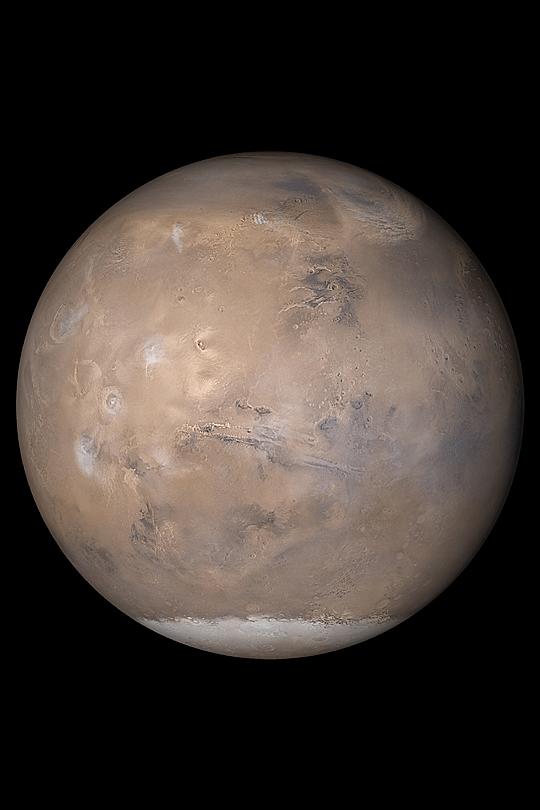
Image: Global view of Mars showing its characteristic red color, polar ice caps, and surface features. Credit: NASA/JPL/MSSS
Introduction
Mars has been a focus of scientific and public interest for decades, and for good reason. The "Red Planet" gets its distinctive color from iron oxide—essentially rust—that coats its surface, giving it that characteristic reddish hue we can see from Earth. But Mars's true appeal lies deeper: in its potential for life, both past and present, and in its role as humanity's next destination in space.
While Mars today is a cold, dry desert with a thin atmosphere that provides little protection from radiation, evidence from numerous missions reveals a past that was dramatically different. Imagine Mars billions of years ago: warmer, with a thicker atmosphere, and with flowing water carving river valleys, filling lakes, and possibly even forming oceans. This ancient, habitable Mars may have hosted life, and if life existed, it might still survive in subsurface environments protected from the harsh surface conditions.
The search for life on Mars drives much of the exploration effort, but Mars also represents humanity's next destination in space. Plans for human missions to Mars are advancing, with NASA's Artemis program serving as a stepping stone and private companies like SpaceX developing technologies for Mars colonization. Whether for science or exploration, Mars will continue to be a focus of space programs worldwide.
Understanding Mars means understanding planetary evolution, climate change, and the potential for life beyond Earth. As we continue to explore Mars with rovers like Perseverance and future missions, we're learning not just about another planet, but about the conditions that create and sustain life, and about humanity's future in space. Mars teaches us about how planets can lose their atmospheres, how climates can change dramatically, and how life might adapt to extreme conditions—lessons that are relevant not just for understanding Mars, but for understanding Earth's future and the potential for life elsewhere in the universe.
Physical Characteristics
Size and Orbit
Mars is significantly smaller than Earth:
- Radius: 3,390 km (Earth: 6,371 km) - about 53% of Earth's radius
- Mass: 6.4 × 10²³ kg (10% of Earth's mass) - about 0.107 Earth masses
- Orbital period: 687 Earth days (1.88 Earth years) - a Martian year
- Distance from Sun: 1.5 AU (Earth: 1 AU) - about 228 million km on average
- Surface area: Approximately 144 million km² (about 28% of Earth's land area)
Mars's orbit is more elliptical than Earth's (eccentricity 0.093 vs. 0.017), causing significant seasonal variations. Mars is closest to the Sun (perihelion) during southern summer, making southern summers hotter and shorter than northern summers. This orbital eccentricity, combined with Mars's axial tilt of 25.2° (similar to Earth's 23.5°), creates complex seasonal patterns.
Surface
Mars's surface shows evidence of a complex geological history:
- Volcanoes: Olympus Mons, the largest volcano in the solar system, stands 21 km high (nearly 2.5 times Mount Everest) and 600 km wide. Mars hosts several other massive shield volcanoes, including Tharsis Montes and Elysium Mons, indicating extensive past volcanism.
- Canyons: Valles Marineris, a massive canyon system stretching 4,000 km long, up to 7 km deep, and 200 km wide—nearly 10 times longer and 4 times deeper than Earth's Grand Canyon. This system suggests significant tectonic activity in Mars's past.
- Polar caps: Water and carbon dioxide ice caps at both poles, which grow and shrink with the seasons. The northern cap is primarily water ice, while the southern cap has a permanent carbon dioxide ice layer.
- Impact craters: Evidence of ancient bombardment, with some craters dating back billions of years. The heavily cratered southern highlands contrast with the smoother northern lowlands, suggesting different geological histories.
- River valleys: Extensive networks of ancient water-carved features, including Nirgal Vallis, Mawrth Vallis, and hundreds of others, providing strong evidence for past flowing water.
The surface is primarily basalt and other volcanic rocks, covered by a layer of fine dust and sand. The iron oxide (rust) in the surface material gives Mars its characteristic red color. The surface also contains evidence of past aqueous alteration, with clay minerals and other water-formed minerals found in many locations.
Atmosphere
Mars has a thin atmosphere that has evolved dramatically over time:
- Pressure: ~0.6% of Earth's surface pressure (about 6 millibars at the surface, compared to Earth's 1,013 millibars). This is equivalent to the pressure at about 35 km altitude on Earth.
- Composition: 95% CO₂ (carbon dioxide), 3% N₂ (nitrogen), 2% Ar (argon), with trace amounts of oxygen, water vapor, and other gases. The high CO₂ content suggests Mars once had a thicker atmosphere that has been lost over time.
- No oxygen: Not breathable by humans—oxygen levels are only about 0.13%, far below the 21% on Earth.
- Dust storms: Can cover the entire planet, lasting for weeks or months. These global dust storms can raise surface temperatures by blocking sunlight and trapping heat, demonstrating the atmosphere's role in climate despite its thinness.
The thin atmosphere provides little protection from solar radiation and cosmic rays, making the surface a harsh environment. The low pressure means liquid water cannot exist on the surface today—it would either freeze or boil away immediately. However, evidence suggests the atmosphere was once much thicker, possibly allowing liquid water to flow on the surface billions of years ago.
Geological History
Early Mars (4+ billion years ago)
Ancient Mars was very different:
- Warmer climate: Possibly above freezing
- Liquid water: Rivers, lakes, possibly oceans
- Thicker atmosphere: Provided greenhouse warming
- Active geology: Volcanism, tectonics, water activity
Evidence for this past includes:
- River valleys: Carved by flowing water
- Lake beds: Sedimentary deposits
- Deltas: Where rivers entered bodies of water
- Mineral evidence: Clays and other water-formed minerals
Climate Change
Mars's climate changed dramatically:
- Atmosphere loss: Solar wind stripped away atmosphere
- Cooling: Loss of greenhouse effect
- Water loss: Surface water froze or escaped to space
- Drying: Planet became a desert
The timing and causes of this change are still being studied.
Current Mars
Today's Mars is:
- Cold: Average temperature -60°C
- Dry: No surface liquid water
- Inactive: Little geological activity
- Radiation: High surface radiation due to thin atmosphere
However, subsurface water ice exists, and liquid water may exist in some locations.
Potential for Life
Past Life
Ancient Mars may have hosted life:
- Habitability: Warmer, wetter conditions
- Time: Billions of years of potentially habitable conditions
- Energy: Chemical energy sources available
- Evidence: None found yet, but search continues
If life existed, it might have left:
- Fossils: In ancient sedimentary rocks
- Biosignatures: Chemical or isotopic evidence
- Organic molecules: Preserved in rocks
Present Life
Life might still exist on Mars:
- Subsurface: Protected from surface conditions
- Liquid water: Possible in some subsurface locations
- Energy: Chemical energy from rock-water interactions
- Protection: From radiation and cold
However, no evidence of present life has been found.
Search Strategies
Missions search for life by:
- Analyzing rocks: Looking for biosignatures
- Drilling: Accessing subsurface samples
- Detecting gases: Methane and other potential biosignatures
- Returning samples: Bringing samples to Earth for detailed analysis
The search is challenging due to:
- Contamination: Must avoid contaminating Mars
- False positives: Abiotic processes can mimic life
- Detection limits: Life may be rare or hard to detect
Exploration
Past Missions
Viking (1976): First successful landers, searched for life (inconclusive)
Pathfinder/Sojourner (1997): First rover, demonstrated mobility
Spirit and Opportunity (2004): Long-lived rovers, found evidence of past water
Phoenix (2008): Confirmed water ice in polar regions
Curiosity (2012-present): Exploring Gale Crater, finding habitable environments
Perseverance (2021-present): Collecting samples for return to Earth
Current and Future Missions
Perseverance (2021-present):
- Location: Jezero Crater, an ancient river delta
- Achievements: Collected 24 rock and soil samples, found organic molecules, detected ancient habitable environments
- Instruments: PIXL, SHERLOC, SuperCam for detailed analysis
- Status: Continuing exploration, samples await return to Earth
Ingenuity (2021-2024):
- First helicopter on another planet
- Completed 72 flights, far exceeding original 5-flight mission
- Demonstrated powered flight in thin Martian atmosphere
- Final flight completed January 2024
Mars Sample Return (planned, 2030s):
- Mission: Return Perseverance's samples to Earth
- Components: Sample retrieval lander, Mars Ascent Vehicle, Earth Return Orbiter
- Significance: First return of samples from another planet
- Challenges: Complex multi-mission architecture, high cost
Human Missions:
- NASA: Planning for 2030s-2040s timeframe
- SpaceX: Developing Starship for Mars missions
- Challenges: Radiation, life support, long-duration spaceflight
Challenges
Human Exploration
Sending humans to Mars faces:
- Distance: 6-9 months travel time
- Radiation: High exposure during transit and on surface
- Life support: Must provide air, water, food
- Isolation: Far from Earth, limited communication
- Cost: Extremely expensive
Life Detection
Finding life is difficult:
- Rare: Life may be rare or absent
- Hidden: May be in inaccessible locations
- Contamination: Must avoid false positives
- Detection: Requires sophisticated instruments
Data and Resources
NASA and JPL Resources
For those interested in exploring Mars data and imagery directly:
- NASA Mars Exploration Program: mars.nasa.gov - Comprehensive hub for all Mars missions, news, and discoveries
- NASA Solar System Exploration: Mars: solarsystem.nasa.gov/planets/mars/overview/ - Detailed overview, facts, and latest discoveries
- JPL Mars Missions: jpl.nasa.gov/missions?mission_type=Mars - All JPL Mars missions
- Mars 2020 / Perseverance: mars.nasa.gov/mars2020 - Official Perseverance rover mission page
- Mars Science Laboratory / Curiosity: mars.nasa.gov/msl - Curiosity rover mission page
- Planetary Data System: pds.nasa.gov - Archive of all NASA planetary mission data
Image Galleries
- Mars Photojournal: photojournal.jpl.nasa.gov/targetFamily/Mars - Public domain images of Mars from all missions
- Mars Exploration Rovers: mars.nasa.gov/mer - Spirit and Opportunity image galleries
- Mars Reconnaissance Orbiter: mars.nasa.gov/mro - High-resolution orbital images
- Mars 2020 Image Gallery: mars.nasa.gov/mars2020/multimedia/raw-images - Raw images from Perseverance
Scientific Data
- Mars Global Surveyor Data: msss.com/mars_images - MGS image data
- HiRISE: hirise.lpl.arizona.edu - High-resolution images from MRO
- Mars Weather: mars.nasa.gov/insight/weather - Current weather data from InSight
Conclusion
Mars represents humanity's best opportunity to find life beyond Earth and our next destination in space exploration. The evidence for a past habitable Mars is strong—river valleys, lake beds, deltas, and mineral evidence all point to a world that was once warmer and wetter, with conditions that could have supported life. The search for signs of past or present life continues with missions like Perseverance, which has already found organic molecules and evidence of ancient habitable environments.
Whether life exists or existed on Mars remains unknown, but the search advances our understanding of life's potential in the universe. The discovery of life on Mars—even if it's just fossilized microbes—would be one of the most profound discoveries in human history, revealing that life is not unique to Earth and potentially common throughout the universe.
For related topics:
- Phobos and Deimos - Mars's two small moons
- Earth - Our home planet, Mars's neighbor
- Venus - The other inner planet
- Europa - Jupiter's moon with potential for life
- Planetary Science & Space - Overview of planetary science topics
Mars exploration has made remarkable progress, with rovers, orbiters, and landers providing detailed information about the planet's geology, climate history, and potential for life. Future missions will return samples to Earth (the first samples from another planet) and eventually send humans to Mars, opening a new chapter in space exploration. The challenges are enormous—radiation, life support, long-duration spaceflight—but the potential rewards are equally great.
The exploration of Mars is far from complete. As we continue to study this fascinating world, we'll learn about planetary evolution, the potential for life, and humanity's future in space. Mars may hold answers to some of our deepest questions about life in the universe and our place in it. Whether we find life or not, Mars will teach us about how planets evolve, how climates change, and how life might arise and persist in diverse environments throughout the cosmos.
References
-
Carr, M. H. (2006). The Surface of Mars. Cambridge University Press. ISBN: 978-0521872010
Comprehensive book on Mars's surface geology and features.
-
Jakosky, B. M. (2019). The Search for Life on Mars. MIT Press. ISBN: 978-0262043017
Overview of the search for life on Mars, past and present.
-
NASA Mars Exploration. (2024). Mars Exploration Program. mars.nasa.gov
Official NASA website for Mars exploration with current mission status and discoveries.
-
Grotzinger, J. P., et al. (2014). "A habitable fluvio-lacustrine environment at Yellowknife Bay, Gale Crater, Mars." Science, 343(6169), 1242777. DOI: 10.1126/science.1242777
Evidence for a past habitable environment in Gale Crater from the Curiosity rover.
-
Ehlmann, B. L., et al. (2011). "Subsurface water and clay mineral formation during the early history of Mars." Nature, 479(7371), 53-60. DOI: 10.1038/nature10582
Evidence for subsurface water and clay formation on early Mars.
-
Webster, C. R., et al. (2018). "Background levels of methane in Mars' atmosphere show strong seasonal variations." Science, 360(6393), 1093-1096. DOI: 10.1126/science.aat5056
Detection of seasonal methane variations in Mars's atmosphere, a potential biosignature.
-
Farley, K. A., et al. (2020). "Mars 2020 mission overview." Space Science Reviews, 216(8), 142. DOI: 10.1007/s11214-020-00762-y
Overview of the Perseverance rover mission and its science objectives.
-
Mustard, J. F., et al. (2008). "Hydrated silicate minerals on Mars observed by the Mars Reconnaissance Orbiter CRISM instrument." Nature, 454(7202), 305-309. DOI: 10.1038/nature07097
Detection of hydrated minerals on Mars, evidence for past water activity.
-
Squyres, S. W., et al. (2004). "The Spirit Rover's Athena science investigation at Gusev Crater, Mars." Science, 305(5685), 794-799. DOI: 10.1126/science.3050794
Results from the Spirit rover's exploration of Gusev Crater.
-
Golombek, M., et al. (2012). "Selection of the Mars Science Laboratory landing site." Space Science Reviews, 170(1-4), 641-737. DOI: 10.1007/s11214-012-9916-y
Selection process and rationale for the Curiosity rover's landing site in Gale Crater.
Recommended Reading
Non-Fiction
For readers interested in learning more about Mars, the following books provide excellent coverage:
-
Bell, J. (2006). Postcards from Mars: The First Photographer on the Red Planet. Dutton. ISBN: 978-0525951331 - Beautiful collection of images from the Mars rovers with explanations.
-
Squyres, S. (2005). Roving Mars: Spirit, Opportunity, and the Exploration of the Red Planet. Hyperion. ISBN: 978-1401301493 - First-hand account of the Mars Exploration Rovers mission by the principal investigator.
-
Zubrin, R. (2011). The Case for Mars: The Plan to Settle the Red Planet and Why We Must. Free Press. ISBN: 978-1451608113 - Comprehensive plan for human exploration and settlement of Mars.
Science Fiction
For readers interested in science fiction that explores Mars and other planets, the following books offer compelling visions of planetary exploration and colonization:
-
Robinson, K. S. (1993). Red Mars. Bantam Books. ISBN: 978-0553560732 - The first book in the acclaimed Mars trilogy, following the first hundred colonists as they begin terraforming Mars. A masterpiece of hard science fiction that explores the scientific, political, and social challenges of Mars colonization.
-
Robinson, K. S. (1994). Green Mars. Bantam Books. ISBN: 978-0553572391 - The second book in the trilogy, set decades later as Mars becomes more habitable and the political landscape evolves. Explores the ongoing terraforming process and the emergence of a new Martian society.
-
Robinson, K. S. (1996). Blue Mars. Bantam Books. ISBN: 978-0553572407 - The concluding volume of the trilogy, set centuries after the initial colonization. Mars has been transformed into a habitable world with oceans and a breathable atmosphere, and humanity must decide its future among the planets.
-
Weir, A. (2011). The Martian. Crown. ISBN: 978-0553418026 - A gripping survival story of an astronaut stranded on Mars, combining accurate science with compelling storytelling. The book was adapted into a major motion picture.
-
Bear, G. (1993). Moving Mars. Tor Books. ISBN: 978-0812513752 - A hard science fiction novel exploring Mars's independence from Earth and the political and scientific challenges of a Martian colony.
-
Bova, B. (1992). Mars. Bantam Books. ISBN: 978-0553291988 - The first book in Bova's Grand Tour series, following the first human mission to Mars and the discovery of ancient life. Combines accurate planetary science with compelling adventure.
-
Clarke, A. C. (1951). The Sands of Mars. Gnome Press. ISBN: 978-0575072298 - An early classic of Mars science fiction, written before the first space missions revealed Mars's true nature. Shows how scientific understanding of Mars has evolved.
-
Burroughs, E. R. (1912). A Princess of Mars. A. C. McClurg. ISBN: 978-0486411535 - The first book in the Barsoom series, a classic of early science fiction that inspired generations of Mars stories. While scientifically outdated, it remains a foundational work of planetary romance.