Jupiter: The King of Planets and Guardian of the Inner Solar System
Jupiter is the largest planet in the solar system, a gas giant so massive that it contains more than twice the mass of all other planets combined. With its iconic Great Red Spot—a storm larger than Earth that has raged for at least 400 years—and its system of 95 known moons including the four large Galilean moons, Jupiter is a world of superlatives. The planet's immense gravity has shaped the solar system, protecting the inner planets from asteroid impacts while also potentially preventing the formation of a super-Earth. Jupiter's composition, primarily hydrogen and helium with traces of other elements, provides a window into the solar nebula from which the planets formed. The planet's powerful magnetic field, the strongest in the solar system, creates a magnetosphere so large that it would appear larger than the full Moon if visible from Earth. Recent discoveries from NASA's Juno mission have revealed that Jupiter's interior is far more complex than previously thought, with a fuzzy core, deep atmospheric flows, and unexpected polar cyclones. This article explores Jupiter's structure, atmospheric dynamics, magnetic field, moon system, and its role as both a protector and potential threat to the inner solar system.
In Simple Terms
Imagine a planet so big that you could fit all the other planets inside it and still have room left over—that's Jupiter, the king of planets. It's a giant ball of gas, mostly hydrogen and helium, with no solid surface to stand on. If you tried to land on Jupiter, you'd just sink deeper and deeper into its thick atmosphere until the pressure crushed you. Jupiter is famous for its Great Red Spot, which is actually a giant storm bigger than Earth that's been raging for at least 400 years—imagine a hurricane that never stops and is bigger than our entire planet! Jupiter also has 95 moons, including four big ones called the Galilean moons: Io (the most volcanically active place in the solar system), Europa (which might have an ocean under its ice), Ganymede (the biggest moon in the solar system), and Callisto (an ancient, cratered world). Jupiter's gravity is so strong it acts like a cosmic vacuum cleaner, sucking up asteroids and comets that might otherwise hit the inner planets, making it a protector of Earth and the other inner worlds. But it's also so massive that its gravity has shaped how the entire solar system formed and evolved.
Abstract
Jupiter is the fifth planet from the Sun, orbiting at an average distance of 778.5 million kilometers (5.2 AU). With a radius of 69,911 km and a mass of 1.90 × 10²⁷ kg, Jupiter is 11 times wider than Earth and 318 times more massive. The planet is a gas giant, composed primarily of hydrogen (89%) and helium (10%), with no solid surface. Jupiter's rapid rotation (9.9 hours) creates a banded appearance with alternating light zones and dark belts, driven by powerful east-west jet streams. The Great Red Spot, a persistent anticyclonic storm, is larger than Earth and has been observed for at least 400 years, though it has been shrinking in recent decades. Jupiter's interior structure remains uncertain, but models suggest a dense core of rock and ice surrounded by a layer of metallic hydrogen, where hydrogen behaves like a liquid metal due to extreme pressure. This metallic hydrogen layer is thought to generate Jupiter's powerful magnetic field, which is 20,000 times stronger than Earth's and creates a magnetosphere extending millions of kilometers. Jupiter has 95 known moons, including the four large Galilean moons—Io, Europa, Ganymede, and Callisto—each a world in its own right. The Juno mission (2016-present) has revolutionized our understanding of Jupiter, revealing a fuzzy core, deep atmospheric structure, polar cyclones, and complex magnetic field. This article reviews Jupiter's physical characteristics, atmospheric dynamics, interior structure, magnetic field, moon system, and ongoing exploration.
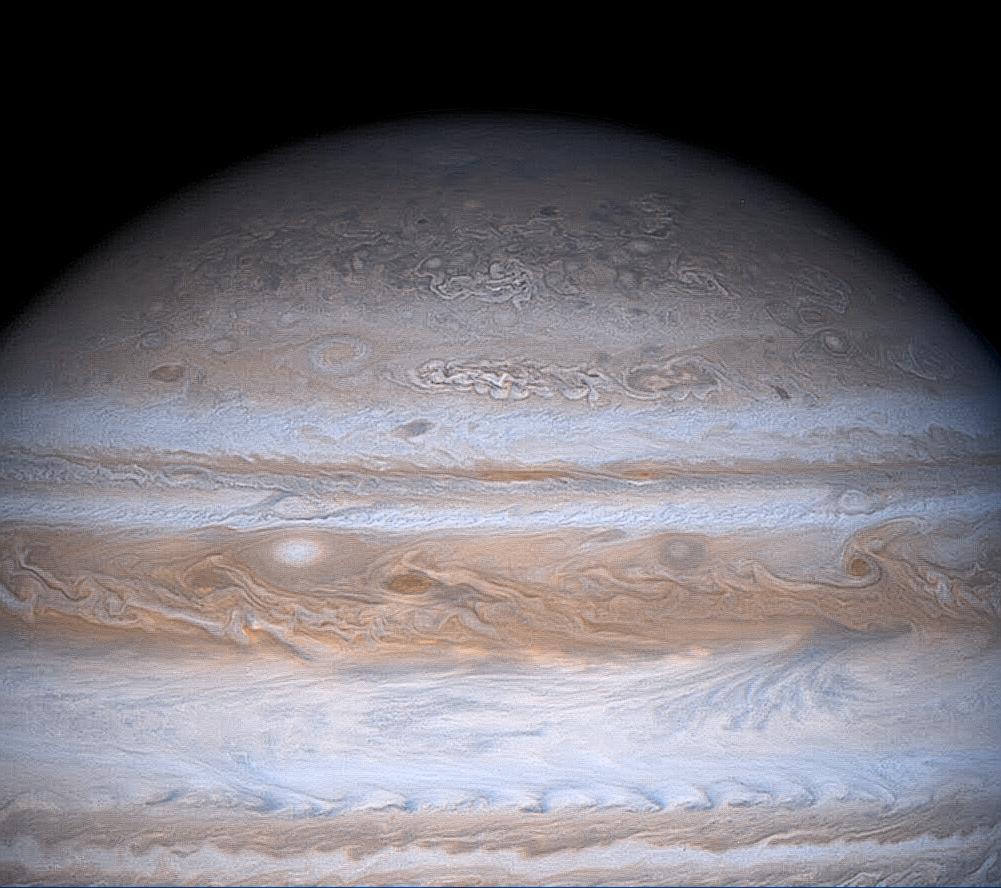
 Jupiter as seen by the Juno spacecraft, showing its banded atmosphere and Great Red Spot. Credit: NASA/JPL-Caltech/SwRI/MSSS (Public Domain)
Introduction
Jupiter has been known since ancient times as the "wandering star" that moves slowly across the sky. Galileo Galilei's discovery of Jupiter's four large moons in 1610 provided crucial evidence for the Copernican model of the solar system, showing that not everything orbited Earth. Today, Jupiter continues to reveal new secrets, with the Juno mission providing unprecedented insights into the planet's interior and atmosphere.
Jupiter's role in the solar system is profound. Its massive gravity has likely:
- Cleared the early solar system of debris, protecting the inner planets
- Prevented the formation of a super-Earth in the inner solar system
- Captured asteroids and comets, some of which may have delivered water to Earth
- Created the asteroid belt through orbital resonances
Understanding Jupiter is essential for understanding:
- The formation of gas giants and exoplanets
- The early history of the solar system
- The potential for life on its moons, particularly Europa
- The dynamics of planetary atmospheres and magnetic fields
Physical Characteristics
Basic Properties
Jupiter is the largest planet in the solar system:
- Equatorial radius: 69,911 km (11.2 Earth radii)
- Polar radius: 66,854 km (flattened due to rapid rotation)
- Mass: 1.90 × 10²⁷ kg (318 Earth masses)
- Density: 1.33 g/cm³ (less dense than water)
- Surface gravity: 24.79 m/s² (2.5 times Earth's gravity)
- Escape velocity: 59.5 km/s
Jupiter's low density indicates it's composed primarily of light elements (hydrogen and helium), similar to the Sun's composition.
Orbit and Rotation
Jupiter orbits relatively far from the Sun:
- Semi-major axis: 778.5 million km (5.2 AU)
- Orbital period: 11.86 Earth years
- Eccentricity: 0.049 (slightly elliptical)
- Rotation period: 9.9 hours (fastest of all planets)
Jupiter's rapid rotation creates significant flattening: the equatorial diameter is 9,275 km larger than the polar diameter.
Composition and Structure
Atmospheric Composition
Jupiter's atmosphere, by volume:
- Hydrogen: 89% (molecular H₂)
- Helium: 10%
- Methane: 0.3%
- Ammonia: 0.026%
- Water vapor: 0.0004% (variable)
- Trace gases: Ethane, phosphine, hydrogen sulfide, etc.
This composition is similar to the solar nebula from which the planets formed, making Jupiter a "failed star"—it has the right composition but not enough mass to ignite fusion (would need ~80 times more mass).
Internal Structure
Jupiter's interior is divided into layers, though the boundaries are not well understood:
Atmosphere (0-1,000 km):
- Cloud layers of ammonia, ammonium hydrosulfide, and water
- Temperature and pressure increase with depth
- No clear boundary between "atmosphere" and "interior"
Molecular hydrogen layer (1,000-20,000 km):
- Hydrogen in molecular form (H₂)
- Pressure: 1-3 million bar
- Temperature: 2,000-10,000 K
Metallic hydrogen layer (20,000-50,000 km):
- Hydrogen behaves like a liquid metal
- Pressure: 3-40 million bar
- Temperature: 10,000-20,000 K
- This layer is thought to generate Jupiter's magnetic field
Core (center):
- Composition uncertain: possibly rock and ice
- Mass: 10-40 Earth masses
- Radius: ~10,000-20,000 km
- Juno data suggests the core may be "fuzzy" or partially dissolved
Atmospheric Dynamics
Banded Structure
Jupiter's most striking feature is its banded appearance:
- Zones: Light-colored bands (rising air, high-pressure regions)
- Belts: Dark-colored bands (sinking air, low-pressure regions)
- Number: ~20 alternating zones and belts
- Colors: Created by different cloud compositions and chemistry
The bands are created by Jupiter's rapid rotation and internal heat, driving powerful atmospheric circulation.
Jet Streams
Jupiter has the fastest winds in the solar system:
- Speed: Up to 150 m/s (540 km/h) in the equatorial jet
- Direction: Alternating east-west in different bands
- Stability: Jet streams are remarkably stable, persisting for decades
These jet streams are driven by:
- Jupiter's rapid rotation (Coriolis effect)
- Internal heat (Jupiter radiates more heat than it receives from the Sun)
- Convection in the deep atmosphere
The Great Red Spot
The Great Red Spot is Jupiter's most famous feature:
- Size: Currently ~16,000 km × 12,000 km (larger than Earth, but shrinking)
- Type: Anticyclonic storm (high-pressure system)
- Age: Observed for at least 400 years (possibly much older)
- Color: Red-orange, possibly due to phosphorus or sulfur compounds
- Rotation: Counter-clockwise, completes one rotation in ~6 days
The Great Red Spot has been shrinking:
- 1800s: ~40,000 km wide
- 1979 (Voyager): ~23,000 km wide
- 2024: ~16,000 km wide
It may disappear within decades or transform into a different type of storm.
Other Storms and Features
Jupiter's atmosphere is constantly changing:
- White ovals: Long-lived anticyclonic storms
- Brown barges: Dark features in the North Equatorial Belt
- Festoons: Plumes that extend from belts into zones
- Polar cyclones: Discovered by Juno, persistent cyclones at both poles
The Magnetic Field
Strength and Structure
Jupiter has the strongest magnetic field in the solar system:
- Strength: ~420,000 nT at cloud tops (20,000 times Earth's field)
- Dipole moment: 20,000 times Earth's
- Tilt: ~10° from rotation axis
- Source: Dynamo in the metallic hydrogen layer
The magnetic field is generated by convection in the electrically conducting metallic hydrogen, combined with Jupiter's rapid rotation.
The Magnetosphere
Jupiter's magnetosphere is enormous:
- Size: Extends 5-7 million km toward the Sun, 1 billion km away from the Sun (beyond Saturn's orbit)
- If visible: Would appear larger than the full Moon from Earth
- Structure: Shaped by solar wind on the sunward side, elongated tail on the opposite side
The magnetosphere:
- Traps charged particles in radiation belts (much more intense than Earth's Van Allen belts)
- Creates auroras at the poles (brighter and more extensive than Earth's)
- Interacts with Io, creating a plasma torus and intense radiation
The Moon System
Jupiter has 95 known moons, the most of any planet, forming a miniature solar system around the gas giant. The moons range from tiny captured asteroids to the massive Galilean moons, which are worlds in their own right.
The Galilean Moons
The four large moons discovered by Galileo Galilei in 1610 are among the most fascinating objects in the solar system:
Io: Most volcanically active body in the solar system
- Tidal heating from Jupiter's immense gravity creates hundreds of active volcanoes, constantly renewing the surface
- Surface covered in sulfur and sulfur dioxide, creating a colorful, ever-changing landscape
- No impact craters (surface constantly renewed by volcanic activity)
- Extreme radiation environment due to proximity to Jupiter's magnetosphere
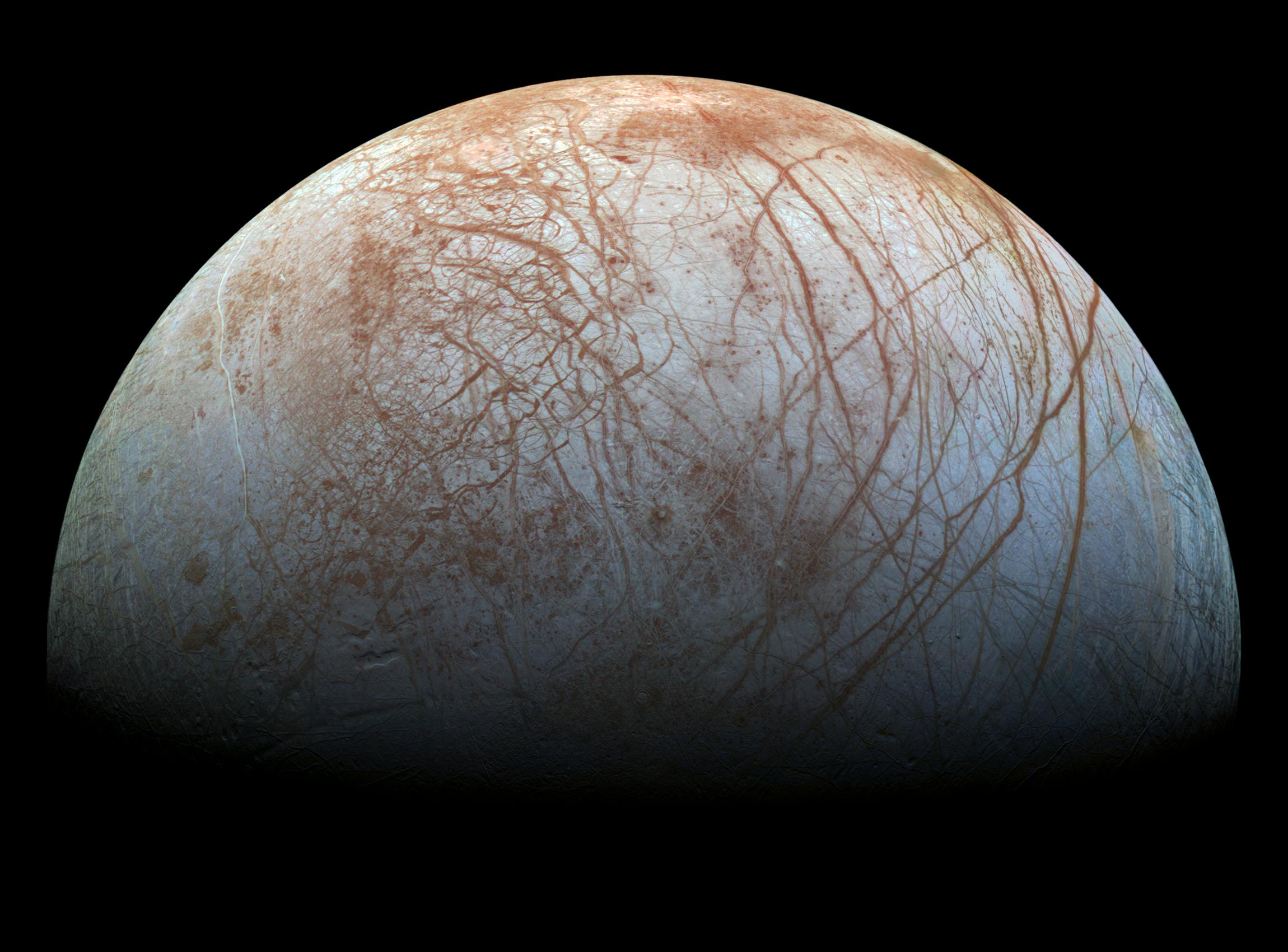
Europa: Icy moon with a subsurface ocean
- Global ocean beneath 10-30 km ice shell, containing more water than all of Earth's oceans combined
- Potential for life in the ocean, making it one of the most promising targets for astrobiology
- Target for the Europa Clipper mission, which will study the moon in detail starting in 2030
- Young, smooth surface with linear features suggesting active ice tectonics
Ganymede: Largest moon in the solar system
- Larger than Mercury, with a radius of 2,631 km
- Only moon known to have its own magnetic field, generated by a liquid iron core
- Subsurface ocean possible, with multiple layers of ice and ocean
- Complex geology with both ancient, heavily cratered terrain and younger, grooved terrain
Callisto: Most distant Galilean moon
- Heavily cratered, ancient surface preserving a record of the early solar system
- Possible subsurface ocean, though evidence is less strong than for Europa or Ganymede
- Least affected by Jupiter's gravity, radiation, and tidal forces, making it the most stable of the Galilean moons
Other Moons
Jupiter's other moons include:
- Inner moons: Small, irregular, close to Jupiter
- Irregular moons: Captured asteroids, far from Jupiter, retrograde orbits
- Rings: Faint ring system, discovered by Voyager
Exploration History
Early Observations
- 1610: Galileo discovers the four large moons
- 1665: Cassini observes the Great Red Spot
- 1930s: Spectroscopic observations reveal atmospheric composition
Space Missions
Pioneer 10 & 11 (1973-1974):
- First spacecraft to visit Jupiter
- Discovered the radiation belts
- Mapped the magnetic field
Voyager 1 & 2 (1979):
- Revealed active volcanism on Io
- Discovered Jupiter's rings
- Detailed images of the Galilean moons
- Studied the Great Red Spot
Galileo (1995-2003):
- First orbiter of Jupiter
- Dropped a probe into the atmosphere
- Studied the Galilean moons in detail
- Discovered evidence for Europa's ocean
Juno (2016-present):
- Currently orbiting Jupiter
- Studying the interior, atmosphere, and magnetic field
- Discoveries include:
- Fuzzy, partially dissolved core
- Deep atmospheric flows
- Polar cyclones
- Complex magnetic field structure
Future Missions
Europa Clipper (NASA, planned 2024):
- Will study Europa in detail
- Search for signs of habitability
- Prepare for future lander mission
JUICE (ESA, launched 2023):
- Will study Jupiter and the Galilean moons
- Focus on Ganymede, Europa, and Callisto
- Arrives 2031
Jupiter's Role in the Solar System
Protector and Threat
Jupiter's gravity has complex effects:
Protective effects:
- Clears asteroids and comets from the inner solar system
- May have protected Earth from impacts early in solar system history
Threatening effects:
- Can redirect asteroids and comets toward the inner planets
- May have caused the Late Heavy Bombardment
- Some comets originate from Jupiter's influence
The net effect is debated, but Jupiter likely plays a crucial role in maintaining the stability of the inner solar system.
Formation of the Solar System
Jupiter's composition and position provide clues about solar system formation:
- Formed early, before the inner planets
- Composition reflects the solar nebula
- May have prevented formation of a super-Earth
- Influenced the formation and evolution of other planets
Open Questions
Many mysteries remain about Jupiter:
- Interior structure: What is the exact composition and state of the core?
- Atmospheric depth: How deep do the visible cloud features extend?
- Great Red Spot: Why has it persisted so long, and why is it shrinking?
- Magnetic field: What is the exact mechanism of field generation?
- Water abundance: How much water does Jupiter contain, and where is it?
- Formation: How and when did Jupiter form?
Juno and future missions will continue to probe these mysteries.
Conclusion
Jupiter is a world of extremes and superlatives—the largest planet, the strongest magnetic field, the fastest rotation, the most moons. But it's also a world of profound importance: its gravity shaped the solar system, its composition reveals the solar nebula, and its moons may harbor life. As the Juno mission continues to reveal Jupiter's secrets and future missions prepare to explore its moons, we're gaining new insights into not just Jupiter but the formation and evolution of planetary systems throughout the universe. Understanding Jupiter is essential for understanding our place in the cosmos and the potential for life beyond Earth.
For related topics:
- Europa - Jupiter's moon with a subsurface ocean and potential for life
- Io - The most volcanically active body in the solar system
- Ganymede - The largest moon in the solar system
- Saturn - The ringed planet, Jupiter's neighbor
- Planetary Science & Space - Overview of planetary science topics
^[NASA Solar System Exploration - Jupiter] NASA. (2024). Jupiter: In Depth. NASA Solar System Exploration. https://solarsystem.nasa.gov/planets/jupiter/in-depth/
^[Juno Mission] NASA. (2024). Juno Mission to Jupiter. NASA Jet Propulsion Laboratory. https://www.nasa.gov/mission_pages/juno/main/index.html
^[Galileo Mission] NASA. (2024). Galileo Mission to Jupiter. NASA Jet Propulsion Laboratory. https://solarsystem.nasa.gov/missions/galileo/in-depth/
^[Great Red Spot] Simon, A. A., et al. (2018). Historical and contemporary trends in the size, drift, and color of Jupiter's Great Red Spot. Astronomical Journal, 155(4), 151.
^[Jupiter Interior] Wahl, S. M., et al. (2017). Comparing Jupiter interior structure models to Juno gravity measurements and the role of a dilute core. Geophysical Research Letters, 44(10), 4649-4659.
^[Jupiter Magnetic Field] Connerney, J. E. P., et al. (2018). A new model of Jupiter's magnetic field from Juno's first nine orbits. Geophysical Research Letters, 45(6), 2590-2596.
^[Jupiter Formation] Lambrechts, M., et al. (2019). Formation of Jupiter by nucleated instability. Monthly Notices of the Royal Astronomical Society, 484(2), 2614-2632.
^[Europa Clipper] NASA. (2024). Europa Clipper. NASA Jet Propulsion Laboratory. https://europa.nasa.gov/
^[JUICE Mission] ESA. (2024). Jupiter Icy Moons Explorer (JUICE). European Space Agency. https://www.esa.int/Science_Exploration/Space_Science/Juice
Recommended Reading
Non-Fiction
For readers interested in learning more about Jupiter and its moons, the following books provide excellent coverage:
-
Bagenal, F., Dowling, T. E., & McKinnon, W. B. (Eds.). (2004). Jupiter: The Planet, Satellites and Magnetosphere. Cambridge University Press. ISBN: 978-0521818087 - Comprehensive scientific reference covering all aspects of Jupiter and its system.
-
Rothery, D. A. (2015). Moons: A Very Short Introduction. Oxford University Press. ISBN: 978-0198735274 - Accessible introduction to moons throughout the solar system, including Jupiter's Galilean moons.
-
Taylor, F. W. (2016). Planetary Atmospheres. Oxford University Press. ISBN: 978-0199547423 - Detailed coverage of planetary atmospheres, including Jupiter's complex atmospheric dynamics.
Science Fiction
For readers interested in science fiction featuring Jupiter and its moons:
-
Clarke, A. C. (1973). Rendezvous with Rama. Gollancz. ISBN: 978-0553287899 - Classic hard science fiction novel about a mysterious alien spacecraft entering the solar system, with Jupiter playing a key role in the story.
-
Bova, B. (2000). Jupiter. Tor Books. ISBN: 978-0812568743 - Part of Bova's Grand Tour series, following a mission to explore Jupiter and its moons, particularly Europa, in search of life.
-
Robinson, K. S. (2015). Aurora. Orbit. ISBN: 978-0316098106 - A generation ship story that passes through the outer solar system, including detailed descriptions of Jupiter and its moons.
-
Crichton, M. (1969). The Andromeda Strain. Knopf. ISBN: 978-0394421965 - While not primarily about Jupiter, this classic hard science fiction novel explores themes of alien life and planetary science that relate to the search for life on Jupiter's moons.