Mercury: The Extreme World at the Edge of the Sun
Mercury is the smallest planet in the solar system and the closest to the Sun, orbiting at an average distance of just 0.39 astronomical units. Despite its proximity to the Sun, Mercury experiences some of the most extreme temperature variations in the solar system—from 430°C (800°F) during the day to -180°C (-290°F) at night. This harsh environment, combined with Mercury's unusual 3:2 spin-orbit resonance (rotating three times for every two orbits), creates unique geological features and challenges for exploration. Mercury's large iron core, making up 60% of its mass, suggests a violent formation history that may have stripped away much of its original mantle. Recent missions like NASA's MESSENGER and ESA/JAXA's BepiColombo have revealed a world far more complex than previously imagined, with evidence of water ice in permanently shadowed craters, a tenuous exosphere, and a global magnetic field. This article explores Mercury's extreme environment, geological history, and the mysteries that remain about this enigmatic inner planet.
In Simple Terms
Mercury is like the solar system's extreme athlete—it's the smallest planet and the closest to the Sun, which means it experiences the most dramatic temperature swings of any planet. During the day, when the Sun is shining directly on it, Mercury gets hot enough to melt lead (430°C). But at night, when it's in the shadow, it gets colder than Antarctica (-180°C). This happens because Mercury has almost no atmosphere to trap heat or distribute it around the planet. What's really weird is how Mercury spins—it rotates three times for every two trips around the Sun, which means a day on Mercury (from sunrise to sunrise) is actually longer than its year! Mercury looks a lot like our Moon—covered in craters—but it's actually much denser because it has a huge iron core that takes up most of the planet. Scientists think Mercury might have been much bigger originally, but a giant collision early in its history might have stripped away most of its outer layers, leaving just the dense core. Amazingly, even though Mercury is so close to the Sun, there's actually water ice hiding in craters near the poles that never see sunlight!
Abstract
Mercury is the innermost planet of the solar system, orbiting the Sun at an average distance of 57.9 million kilometers (0.39 AU). With a radius of 2,440 km and a mass of 3.3 × 10²³ kg, Mercury is only slightly larger than Earth's Moon but much denser, with an unusually large iron core comprising approximately 60% of its mass. Mercury's orbit is highly eccentric (0.206), bringing it as close as 46 million km to the Sun at perihelion and as far as 70 million km at aphelion. The planet's 3:2 spin-orbit resonance means it rotates three times for every two orbits, creating a "day" that lasts 176 Earth days—longer than its 88-day year. This slow rotation, combined with the lack of a substantial atmosphere, leads to extreme temperature variations: the dayside reaches 430°C while the nightside drops to -180°C. Despite these harsh conditions, radar observations and MESSENGER data have revealed water ice in permanently shadowed craters near the poles, where temperatures remain below -170°C. Mercury's surface is heavily cratered, similar to the Moon, but also shows evidence of extensive volcanism, tectonic activity, and a global contraction that created thousands of kilometers of scarps. The planet's magnetic field, though only 1% as strong as Earth's, is generated by an active dynamo in its liquid outer core. This article reviews Mercury's physical characteristics, geological history, extreme environment, and ongoing exploration by the BepiColombo mission.
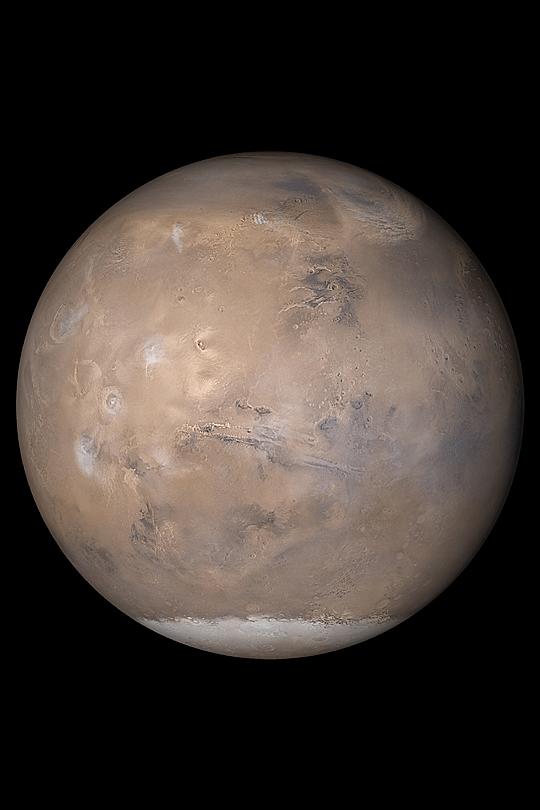
 Mercury as seen by the MESSENGER spacecraft, showing its heavily cratered surface. Credit: NASA/Johns Hopkins University Applied Physics Laboratory/Carnegie Institution of Washington (Public Domain)
Introduction
Mercury has long been one of the most challenging planets to study. Its proximity to the Sun makes it difficult to observe from Earth—the planet is always seen near the Sun in the sky, requiring observations at dawn or dusk. Ground-based telescopes revealed little more than a featureless disk, leading early astronomers to assume Mercury was a simple, Moon-like world. This perception changed dramatically with the Mariner 10 mission in 1974-1975, which provided the first close-up images and revealed a complex, geologically active world.
The MESSENGER mission (2011-2015) revolutionized our understanding of Mercury. The spacecraft orbited the planet for over four years, mapping its surface in detail, measuring its magnetic field, and discovering water ice in polar craters—a finding that seemed impossible given Mercury's proximity to the Sun. MESSENGER revealed that Mercury is not a simple, dead world but a planet with a complex geological history, active processes, and surprising chemical diversity.
Today, the BepiColombo mission (launched 2018) is continuing Mercury exploration, with two orbiters that will study the planet's surface, interior, magnetic field, and exosphere in unprecedented detail. BepiColombo will help answer fundamental questions about Mercury's formation, evolution, and the processes that shaped this extreme world.
Physical Characteristics
Basic Properties
Mercury is the smallest planet in the solar system:
- Radius: 2,440 km (0.38 Earth radii)
- Mass: 3.3 × 10²³ kg (0.055 Earth masses)
- Density: 5.43 g/cm³ (second densest planet after Earth)
- Surface gravity: 3.7 m/s² (0.38 times Earth's gravity)
- Escape velocity: 4.25 km/s
Mercury's high density, despite its small size, indicates an unusually large iron core. The core is estimated to be 3,600 km in radius—75% of the planet's radius—compared to Earth's core, which is only 50% of Earth's radius.
Orbit and Rotation
Mercury's orbit is the most eccentric of the planets:
- Semi-major axis: 57.9 million km (0.39 AU)
- Perihelion: 46.0 million km (0.31 AU)
- Aphelion: 69.8 million km (0.47 AU)
- Eccentricity: 0.206
- Orbital period: 88 Earth days
- Rotation period: 58.6 Earth days (2/3 of orbital period)
The 3:2 spin-orbit resonance means Mercury rotates three times for every two orbits around the Sun. This creates a unique day-night cycle: from sunrise to sunrise on Mercury takes 176 Earth days—exactly two Mercury years. The resonance is stable because it minimizes the tidal forces acting on the planet.
Temperature Extremes
Mercury experiences the most extreme temperature variations in the solar system:
- Dayside maximum: 430°C (800°F) at the equator
- Nightside minimum: -180°C (-290°F)
- Temperature range: 610°C (1,100°F)
The extreme temperatures result from:
- Proximity to the Sun: Receives 6.5 times more solar radiation per unit area than Earth
- Slow rotation: Long days allow the surface to heat and cool dramatically
- No atmosphere: No greenhouse effect or heat redistribution
However, permanently shadowed craters near the poles maintain temperatures below -170°C, cold enough to preserve water ice for billions of years.
Internal Structure
The Large Iron Core
Mercury's most distinctive feature is its enormous iron core:
- Core radius: ~3,600 km (75% of planet radius)
- Core mass: ~60% of total mass
- Core composition: Primarily iron with some nickel and lighter elements
Earth's core, by comparison, is only 50% of Earth's radius and 32% of its mass. Mercury's core is so large that if it were removed, the remaining mantle and crust would be similar in size to Earth's Moon.
Formation Theories
Several theories attempt to explain Mercury's large core:
-
Giant Impact Hypothesis: A massive impact early in Mercury's history may have stripped away much of the outer mantle, leaving the dense core exposed.
-
Solar Nebula Composition: Mercury may have formed from material that was already iron-rich due to the Sun's intense heat vaporizing lighter elements.
-
Evaporation: The Sun's heat may have vaporized and removed the outer layers of a larger proto-Mercury.
Recent MESSENGER data supports the giant impact hypothesis, showing that Mercury's surface has higher concentrations of volatile elements (sulfur, potassium) than expected if the planet had simply lost its outer layers to evaporation.
Magnetic Field
Mercury has a global magnetic field, though it's only 1% as strong as Earth's:
- Field strength: ~300 nT at the equator (Earth: ~30,000 nT)
- Dipole tilt: ~10° from rotation axis
- Source: Active dynamo in liquid outer core
The presence of a magnetic field was surprising because Mercury's core should have cooled and solidified long ago. However, the core appears to have a solid inner core and a liquid outer core, similar to Earth. The dynamo is likely maintained by:
- Thermal convection: Cooling of the core
- Compositional convection: Freezing of the inner core releases lighter elements
Surface Geology
Cratering
Mercury's surface is heavily cratered, similar to the Moon:
- Heavily cratered terrain: Ancient, dating to the Late Heavy Bombardment (~4 billion years ago)
- Intercrater plains: Older, more degraded cratered regions
- Smooth plains: Younger, volcanic in origin
The most prominent feature is the Caloris Basin, a 1,550-km-diameter impact crater that is one of the largest in the solar system. The impact was so powerful that it created "weird terrain" on the opposite side of the planet—hilly, chaotic terrain formed by seismic waves focusing at the antipode.
Volcanism
MESSENGER revealed extensive evidence of volcanism:
- Smooth plains: Cover ~40% of Mercury's surface, formed by flood basalts
- Pyroclastic deposits: Evidence of explosive volcanism
- Volcanic vents: Identified in several locations
The smooth plains are similar to lunar maria but cover a much larger percentage of Mercury's surface. They appear to have formed in multiple episodes, with the youngest being less than 1 billion years old—surprisingly recent for such a small planet.
Tectonic Features
Mercury shows evidence of global contraction:
- Lobate scarps: Long, curved cliffs formed by thrust faulting
- Total length: Over 10,000 km of scarps mapped
- Formation: As Mercury's interior cooled, the planet contracted, causing the crust to wrinkle
The largest scarp, Enterprise Rupes, is over 1,000 km long and up to 3 km high. These features indicate that Mercury has shrunk by approximately 7 km in radius since its formation.
Surface Composition
MESSENGER's X-ray and gamma-ray spectrometers revealed Mercury's surface composition:
- Low iron content: Surface contains only 2-4% iron by weight (much lower than expected)
- High sulfur: Up to 4% sulfur, suggesting the core contains significant sulfur
- High magnesium: Indicates a magnesium-rich mantle
- Volatile elements: Potassium, sodium, and chlorine present in higher abundances than predicted
The low iron content was surprising and suggests that Mercury's surface is not simply exposed core material but has undergone significant geological processing.
The Exosphere and Water Ice
Tenuous Atmosphere
Mercury has no true atmosphere but instead has an exosphere—a thin layer of atoms that don't collide with each other:
- Surface pressure: <10⁻¹² bar (essentially a vacuum)
- Composition: Sodium, potassium, calcium, magnesium, oxygen, hydrogen, helium
- Source: Solar wind sputtering, meteoroid impacts, surface volatiles
The exosphere is constantly being replenished and lost. Atoms are ejected from the surface by solar wind particles, meteoroid impacts, and thermal processes, then either escape to space or fall back to the surface.
Water Ice at the Poles
One of MESSENGER's most surprising discoveries was evidence of water ice in permanently shadowed craters near the poles:
- Location: Craters near the north and south poles
- Evidence: High radar reflectivity consistent with water ice
- Temperature: Below -170°C in permanent shadow
- Source: Likely delivered by comets and asteroids
The ice deposits are covered by a dark, organic-rich layer that may protect them from sublimation. The total amount of water ice is estimated to be equivalent to a layer 2-20 meters thick covering an area of thousands of square kilometers.
Exploration History
Mariner 10 (1974-1975)
NASA's Mariner 10 was the first spacecraft to visit Mercury:
- Three flybys: March and September 1974, March 1975
- Images: Mapped ~45% of Mercury's surface
- Discoveries: Magnetic field, 3:2 spin-orbit resonance, heavily cratered surface
Mariner 10 revealed that Mercury was far more complex than a simple Moon-like world, but its limited coverage left many questions unanswered.
MESSENGER (2011-2015)
NASA's MESSENGER (MErcury Surface, Space ENvironment, GEochemistry, and Ranging) mission provided the first comprehensive study of Mercury:
- Orbital mission: April 2011 to April 2015
- Instruments: Cameras, spectrometers, magnetometer, altimeter
- Key discoveries:
- Water ice in polar craters
- Evidence of recent volcanism
- Global magnetic field from active dynamo
- Low iron, high sulfur surface composition
- Extensive smooth plains
MESSENGER's data continues to be analyzed and has fundamentally changed our understanding of Mercury.
BepiColombo (2018-present)
ESA and JAXA's BepiColombo mission is currently studying Mercury:
- Launched: October 2018
- Arrival: December 2025
- Two orbiters: Mercury Planetary Orbiter (ESA) and Mercury Magnetospheric Orbiter (JAXA)
- Objectives: Study surface, interior, magnetic field, and exosphere in detail
BepiColombo will build on MESSENGER's discoveries, providing higher-resolution data and studying Mercury's magnetosphere and exosphere in unprecedented detail.
Open Questions
Despite extensive exploration, many mysteries remain:
- Formation history: How did Mercury acquire its large iron core?
- Recent volcanism: What processes drove volcanism less than 1 billion years ago?
- Magnetic field: How is the dynamo maintained in such a small planet?
- Water ice: How much ice exists, and what is the dark material covering it?
- Hollows: What process creates the bright, irregular depressions called "hollows"?
BepiColombo and future missions will continue to probe these mysteries, revealing more about this extreme world at the edge of the Sun.
Conclusion
Mercury is a world of extremes—the closest planet to the Sun, with the most eccentric orbit, the largest core relative to its size, and the most extreme temperature variations. Yet it's also a world of surprises: water ice at the poles, recent volcanism, an active magnetic field, and a complex geological history. As the least explored of the inner planets until recently, Mercury continues to reveal new mysteries with each mission. Understanding Mercury is crucial for understanding the formation and evolution of terrestrial planets, the processes that shape planetary surfaces, and the extreme environments that can exist in our solar system.
For related topics:
- Venus - The other inner planet
- Earth - Our home planet
- Mars - The Red Planet
- Moon - Earth's natural satellite, similar in appearance to Mercury
- Planetary Science & Space - Overview of planetary science topics
^[NASA Solar System Exploration - Mercury] NASA. (2024). Mercury: In Depth. NASA Solar System Exploration. https://solarsystem.nasa.gov/planets/mercury/in-depth/
^[MESSENGER Mission] NASA. (2024). MESSENGER Mission to Mercury. Johns Hopkins Applied Physics Laboratory. https://messenger.jhuapl.edu/
^[BepiColombo Mission] ESA. (2024). BepiColombo. European Space Agency. https://www.esa.int/Science_Exploration/Space_Science/BepiColombo
^[Mercury Water Ice] Lawrence, D. J., et al. (2013). Evidence for water ice near Mercury's north pole from MESSENGER Neutron Spectrometer measurements. Science, 339(6117), 292-296.
^[Mercury Formation] Benz, W., et al. (2007). The origin of Mercury. Space Science Reviews, 132(2-4), 189-202.
^[Mercury Geology] Head, J. W., et al. (2011). Flood volcanism in the northern high latitudes of Mercury revealed by MESSENGER. Science, 333(6051), 1853-1856.
^[Mercury Magnetic Field] Anderson, B. J., et al. (2011). The global magnetic field of Mercury from MESSENGER orbital observations. Science, 333(6051), 1859-1862.
Recommended Reading
For readers interested in learning more about Mercury, the following books provide excellent coverage:
-
Strom, R. G., & Sprague, A. L. (2003). Exploring Mercury: The Iron Planet. Springer. ISBN: 978-1852337315 - Comprehensive overview of Mercury's geology, composition, and exploration history.
-
Vilas, F., Chapman, C. R., & Matthews, M. S. (Eds.). (1988). Mercury. University of Arizona Press. ISBN: 978-0816510856 - Scientific reference covering Mercury's physical properties and formation theories.