Triton: Neptune's Captured Moon with Geysers
Triton is Neptune's largest moon and one of the most fascinating worlds in the outer solar system. The moon orbits retrograde (backward), indicating it was likely captured from the Kuiper Belt rather than forming with Neptune. Triton has a young, geologically active surface with few craters, geysers of nitrogen gas, and a thin nitrogen atmosphere. The geysers, discovered by Voyager 2, erupt dark material that creates streaks on the surface. Triton's surface is composed primarily of nitrogen, methane, and water ice, and shows evidence of recent geological activity including cryovolcanism and tectonic features. The moon's retrograde orbit is causing it to spiral inward, and in approximately 3.6 billion years, Triton will either crash into Neptune or be torn apart by tidal forces, forming a ring. This article explores Triton's retrograde orbit, geysers, young surface, likely capture from the Kuiper Belt, and its eventual fate.
In Simple Terms
Imagine a moon that's going the wrong way around its planet—that's Triton, Neptune's largest moon. While most moons orbit in the same direction their planet spins, Triton goes backward, like it's driving the wrong way on a cosmic highway. This tells scientists that Triton wasn't born with Neptune—it was probably captured from the Kuiper Belt, a region of icy objects beyond Neptune. What makes Triton even more amazing is that it has active geysers shooting nitrogen gas and dark material into space, creating streaks across its surface. The surface is incredibly young—less than 100 million years old—which means something is constantly resurfacing it. But Triton's backward orbit is also its doom: Neptune's gravity is slowly pulling it closer, and in about 3.6 billion years, Triton will either crash into Neptune or be torn apart, possibly creating a beautiful ring around the planet. Triton is like a cosmic visitor that's been captured and is now on a slow-motion collision course with its captor.
Abstract
Triton is Neptune's largest moon, with a radius of 1,353 km and a mass of 2.14 × 10²² kg. The moon orbits Neptune at 354,800 km, completing an orbit in 5.88 days. Triton is unique among large moons in having a retrograde orbit (orbits backward relative to Neptune's rotation), indicating it was likely captured from the Kuiper Belt rather than forming with Neptune. The moon has a young, geologically active surface with few craters, geysers of nitrogen gas, and a thin nitrogen atmosphere. The geysers, discovered by Voyager 2, erupt dark material that creates streaks on the surface, suggesting ongoing geological activity. Triton's surface is composed primarily of nitrogen, methane, and water ice, and shows evidence of recent geological activity including cryovolcanism and tectonic features. The moon's retrograde orbit is causing it to spiral inward due to tidal forces, and in approximately 3.6 billion years, Triton will either crash into Neptune or be torn apart by tidal forces, forming a ring. This article reviews Triton's retrograde orbit, geysers, young surface, likely capture from the Kuiper Belt, and exploration by Voyager 2.
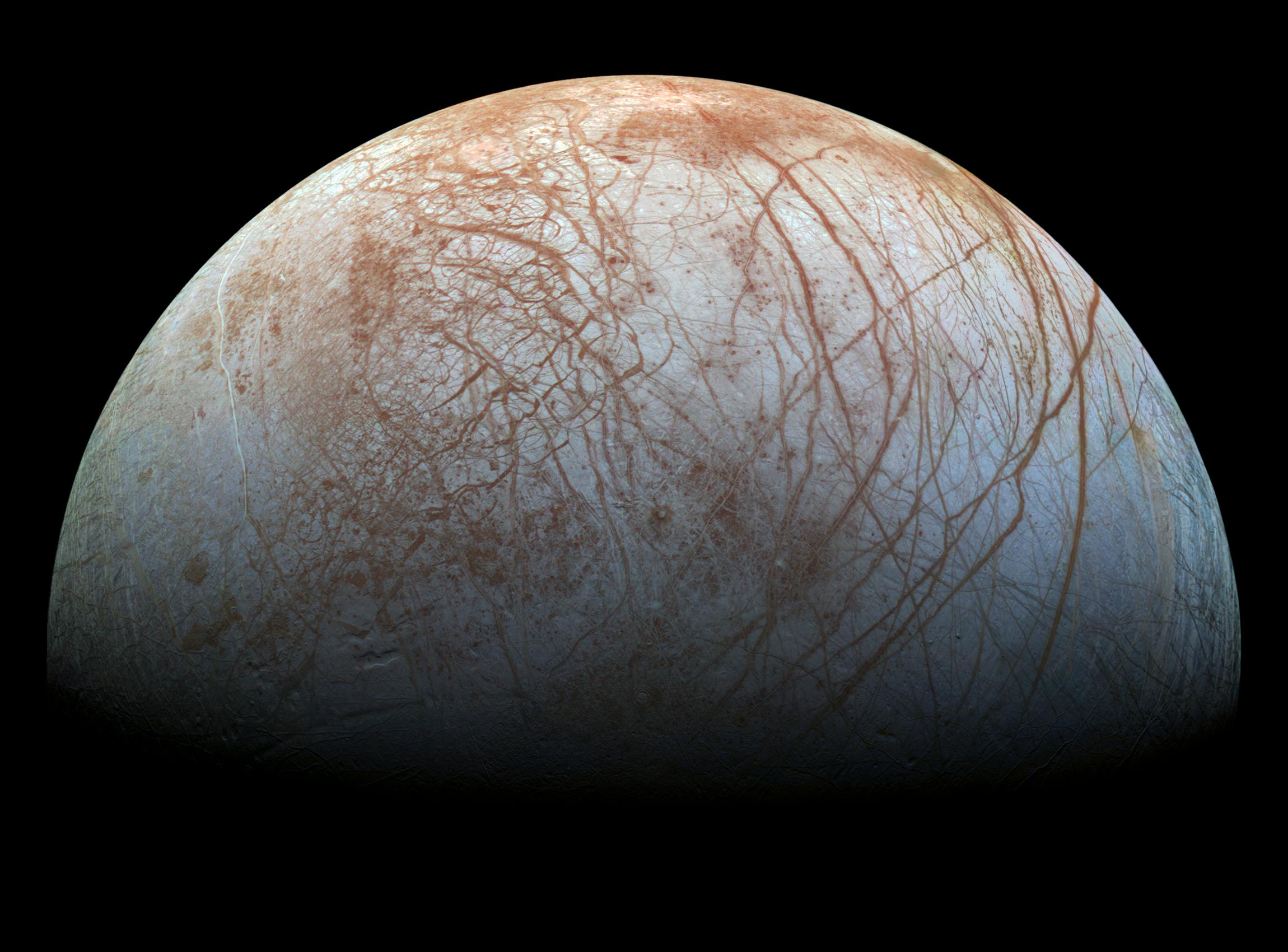
 Triton as seen by Voyager 2, showing its young surface and geyser streaks. Credit: NASA/JPL (Public Domain)
Introduction
Triton, named after the son of Poseidon (Neptune) in Greek mythology, was discovered by William Lassell in 1846, just 17 days after Neptune itself was discovered. The moon gained attention when Voyager 2's 1989 flyby revealed its active geysers and young surface, making it one of the most geologically interesting worlds in the outer solar system.
Triton's retrograde orbit and active geology make it unique among large moons. Understanding Triton is important for understanding the Kuiper Belt, the capture of moons, and the processes that can drive activity on distant worlds.
Physical Characteristics
Basic Properties
Triton is a large icy moon:
- Radius: 1,353 km (slightly smaller than Earth's Moon)
- Mass: 2.14 × 10²² kg
- Density: 2.06 g/cm³ (higher than most icy moons, indicating more rock)
- Surface gravity: 0.78 m/s² (weak)
- Escape velocity: 1.45 km/s
Triton's higher density suggests it's composed of roughly 30% water ice and 70% rock by mass, more rock-rich than typical icy moons.
Orbit
Triton orbits Neptune in a retrograde direction:
- Semi-major axis: 354,800 km
- Orbital period: 5.88 Earth days
- Rotation: Synchronous (same face always toward Neptune)
- Eccentricity: 0.000016 (nearly circular)
- Inclination: 157° (retrograde, orbits backward)
The retrograde orbit is the key evidence that Triton was captured.
Retrograde Orbit and Capture
Evidence for Capture
Triton's retrograde orbit indicates capture:
- Backward motion: Orbits opposite to Neptune's rotation
- Unusual: Most large moons orbit prograde (forward)
- Kuiper Belt origin: Composition and orbit suggest Kuiper Belt origin
- Capture mechanism: Likely captured during a close encounter
Capture Process
Triton was likely captured:
- Original orbit: Heliocentric orbit in Kuiper Belt
- Close encounter: Passed close to Neptune
- Energy loss: Lost energy through interactions or collisions
- Result: Captured into retrograde orbit
The capture would have been violent, heating Triton and possibly explaining its young surface.
Orbital Decay
Triton's orbit is decaying:
- Tidal forces: Neptune's gravity creates tidal forces
- Retrograde effect: Retrograde orbit causes inward spiral
- Rate: Slowly spiraling inward
- Future: Will crash into Neptune or be torn apart in ~3.6 billion years
If torn apart, Triton will form a ring around Neptune.
The Geysers
Discovery
Voyager 2 discovered active geysers:
- Location: South polar region
- Type: Nitrogen geysers
- Height: Plumes extend up to 8 km high
- Material: Dark material carried by nitrogen gas
The geysers were unexpected and make Triton one of the few known geologically active worlds in the outer solar system.
Mechanism
The geysers are driven by:
- Solar heating: Sun heats dark material on surface
- Sublimation: Nitrogen ice sublimates (turns to gas)
- Pressure: Gas pressure builds up
- Eruption: Gas erupts, carrying dark material
The process is similar to geysers on Earth but driven by sublimation rather than boiling.
Surface Streaks
The geysers create dark streaks:
- Direction: Streaks point in direction of prevailing winds
- Length: Can be tens of kilometers long
- Formation: Dark material deposited by geysers
- Evidence: Shows ongoing activity
The streaks provide evidence of active geological processes.
Surface Geology
Young Surface
Triton's surface is remarkably young:
- Few craters: Very low crater density
- Age: Surface less than 100 million years old
- Resurfacing: Active processes constantly renewing surface
- Activity: Ongoing geological activity
The young surface suggests Triton is geologically active today.
Surface Features
Triton shows diverse surface features:
- Cantaloupe terrain: Wrinkled, melon-like texture
- Cryovolcanic features: Possible cryovolcanoes
- Tectonic features: Ridges and fractures
- Polar caps: Nitrogen and methane ice at poles
- Dark streaks: From geyser activity
The diversity suggests complex geological processes.
Surface Composition
Triton's surface is composed of:
- Nitrogen ice: Primary component
- Methane ice: Present in polar regions
- Water ice: Underlying layer
- Dark material: Organic compounds or carbon
The composition is similar to Pluto and other Kuiper Belt objects.
Thin Atmosphere
Nitrogen Atmosphere
Triton has a thin nitrogen atmosphere:
- Composition: Primarily nitrogen
- Surface pressure: ~14 microbars (very thin)
- Source: Sublimation of surface nitrogen ice
- Variability: Changes with seasons and solar heating
The atmosphere is constantly being lost to space and replenished by sublimation.
Composition and Interior
Ice and Rock
Triton's composition:
- Water ice: ~30% by mass
- Rock: ~70% by mass (more rock than typical icy moons)
- Structure: Likely differentiated (ice shell over rocky core)
The higher rock content is consistent with Kuiper Belt origin.
Interior
Triton's interior likely has:
- Ice shell: Outer layer of ice
- Rocky core: Large silicate core
- Possible ocean: Subsurface ocean possible but uncertain
- Heat sources: Radioactive decay, possibly tidal heating
The interior structure is uncertain and requires further study.
Exploration History
Discovery
- 1846: Discovered by William Lassell
- 1989: Voyager 2 provided only close-up images
Voyager 2 (1989)
Voyager 2's brief encounter revealed:
- Active geysers
- Young surface
- Retrograde orbit
- Thin atmosphere
- Complex geology
Voyager 2's data is still being analyzed today.
Scientific Importance
Understanding Kuiper Belt
Triton provides insights into:
- Kuiper Belt composition: Composition of Kuiper Belt objects
- Capture processes: How moons can be captured
- Evolution: How captured objects evolve
Unique Properties
Triton demonstrates:
- Retrograde moons: How retrograde orbits work
- Active outer moons: Geological activity far from Sun
- Geysers: How geysers work on icy worlds
- Orbital evolution: How orbits decay over time
Open Questions
Many mysteries remain about Triton:
- Capture: Exactly how was Triton captured?
- Interior: What is the exact interior structure?
- Ocean: Does Triton have a subsurface ocean?
- Activity: What drives the ongoing activity?
- Future: What will happen when Triton is destroyed?
- Composition: What is the exact composition?
A dedicated mission to Neptune would help answer these questions.
Conclusion
Triton is one of the most fascinating moons in the solar system—a captured Kuiper Belt object with active geysers, a young surface, and a retrograde orbit that will eventually lead to its destruction. Its unique properties make it a key target for understanding the Kuiper Belt, the capture of moons, and the processes that can drive activity on distant worlds. Understanding Triton is essential for understanding the outer solar system and the diversity of worlds that exist there.
For related topics:
- Neptune - The ice giant and Triton's parent world
- Enceladus - Another moon with active geysers
- Europa - Jupiter's moon with a subsurface ocean
- Pluto - A Kuiper Belt object similar to Triton
- Planetary Science & Space - Overview of planetary science topics
^[NASA Solar System Exploration - Triton] NASA. (2024). Triton: In Depth. NASA Solar System Exploration. https://solarsystem.nasa.gov/moons/neptune-moons/triton/in-depth/
^[Triton Geysers] Smith, B. A., et al. (1989). Voyager 2 at Neptune: Imaging science results. Science, 246(4936), 1422-1449.
^[Triton Capture] Agnor, C. B., & Hamilton, D. P. (2006). Neptune's capture of its moon Triton in a binary-planet gravitational encounter. Nature, 441(7090), 192-194.
^[Triton Surface] Croft, S. K., et al. (1995). The geology of Triton. In Neptune and Triton (pp. 879-947). University of Arizona Press.
^[Voyager 2 Triton] Stone, E. C., & Miner, E. D. (1989). The Voyager 2 encounter with the Neptunian system. Science, 246(4936), 1417-1421.